Each layer below is described through the same five-part lens: Purpose, Roles & Responsibilities, Tools, Artifacts, and AI-Assisted Tools & Techniques. This page presents that lens at a summary level for every layer and methodology. Full depth for each methodology (the complete role breakdowns, tool sets, and artifact templates) lives in its own Reference Library entry.
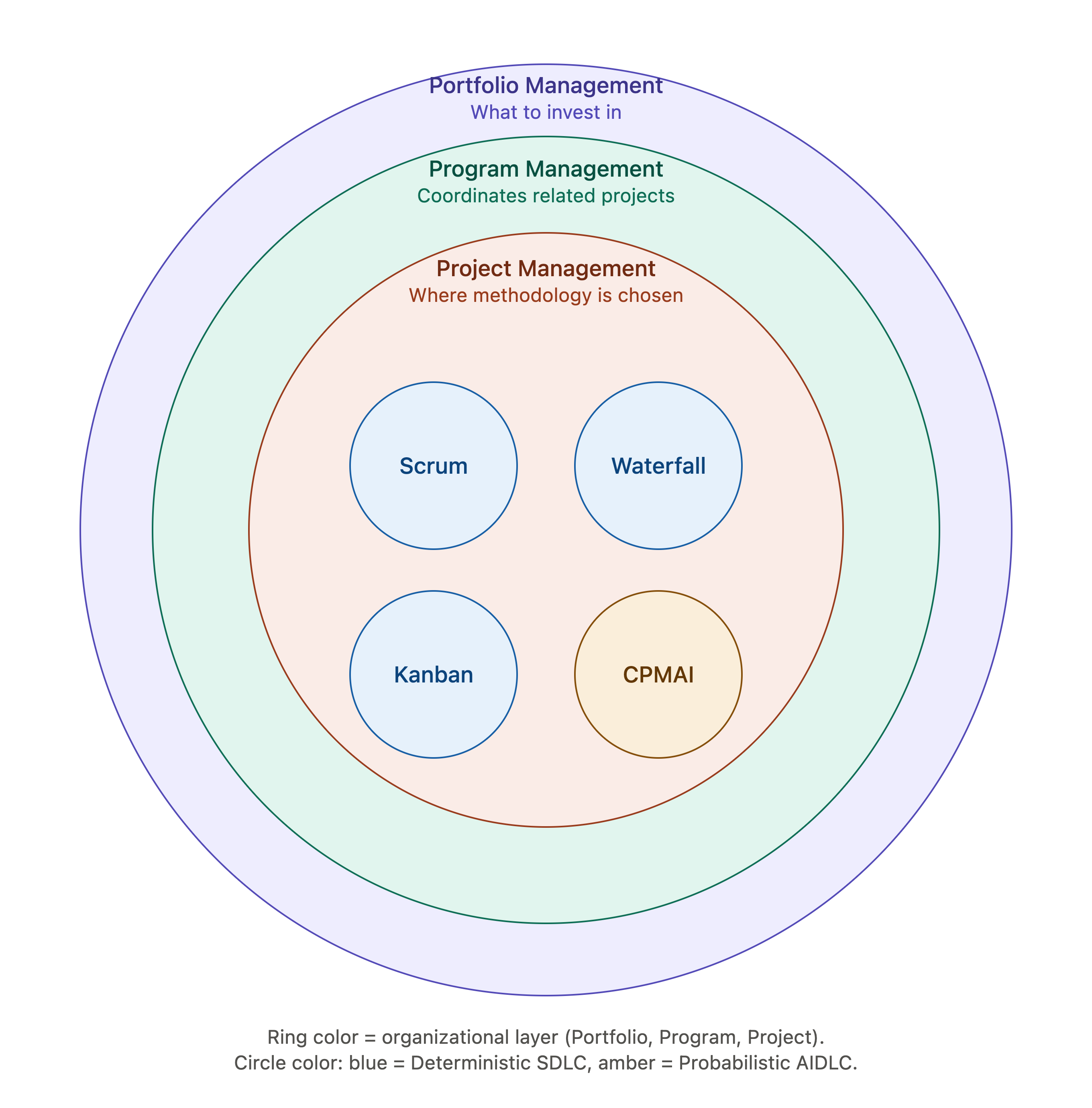
Portfolio Management
Purpose: Ensures the organization is investing in the right technology work: selecting, sequencing, funding, and governing the full set of initiatives so they collectively advance business strategy, rather than simply ensuring individual projects are delivered well.
Roles & Responsibilities: The Portfolio Manager owns strategic alignment, portfolio selection and prioritization, portfolio balancing across run/grow/transform investment categories, governance design, enterprise-level resource allocation, value and benefits oversight, and portfolio-level risk management, then translates all of it into decision support for executives.
Tools: Portfolio management (PPM) platforms, investment scoring and prioritization models, capacity and demand-management tools, executive reporting dashboards.
Artifacts: Portfolio roadmap, investment business cases, prioritization and scoring matrices, benefits realization reports, portfolio risk register, governance charter.
AI-Assisted Tools & Techniques: AI-assisted scoring and ranking of competing investment proposals, benefits-realization tracking synthesis, and enterprise risk-pattern surfacing across initiatives. All of it is an input the Portfolio Manager reviews and authorizes, never the authorization itself.
Program Management
Purpose: Coordinates a group of related projects so they produce a combined business outcome that none of them would achieve managed in isolation: integration and benefits realization, not synchronized timelines.
Roles & Responsibilities: The Program Manager owns program strategy alignment, cross-project interdependency management, program-level benefits management, program governance, stakeholder alignment across business and technical groups, integrated planning, program-level risk and issue management, change coordination, and transition and adoption orchestration.
Tools: Program-level roadmapping and dependency-mapping tools, integrated planning and scheduling platforms, RAID (risk, assumption, issue, dependency) logs, governance and reporting dashboards.
Artifacts: Program charter, integrated program plan, dependency map, benefits realization plan, program risk and issue log, governance and escalation model, stakeholder communication plan.
AI-Assisted Tools & Techniques: AI-assisted dependency mapping across workstreams, cross-team status synthesis, and benefits-tracking pattern detection. The Program Manager still owns sequencing, escalation, and governance calls.
Project Management
Purpose: Guides a specific technology initiative from concept through delivery in a controlled, coordinated, outcome-focused way: the execution layer beneath Portfolio and Program, where a defined effort is planned, managed, and delivered.
Roles & Responsibilities: The Project Manager owns scope and objective definition, planning and delivery coordination, stakeholder alignment, risk and issue management, governance and decision support, cross-functional coordination, resource and capacity coordination, quality oversight, vendor coordination, and business-value focus.
Tools: Project planning and scheduling tools, RAID logs, status and reporting dashboards, and the delivery-tracking tools specific to whichever methodology is in use below.
Artifacts: Project charter, scope statement, delivery plan, risk and issue register, status reports, governance and decision log.
AI-Assisted Tools & Techniques: AI-assisted status aggregation across workstreams, risk-register analysis, dependency mapping, completeness checking of intake and delivery packages, and drafted stakeholder communications. The Project Manager reviews, decides, and owns every output.
Methodology choice happens at this layer, not above it. The two branches below are how a Project Management-level effort actually gets delivered.
Deterministic SDLC
Scrum Methodology
Purpose: The right method when the outcome or end product is genuinely uncertain and iterative discovery is how the team progressively develops and validates the solution, not a way to make delivery feel faster.
Roles & Responsibilities: Product Owner (value maximization, backlog ownership, prioritization, stakeholder representation), Scrum Master (framework guardian, facilitation, coaching, impediment removal, organizational change agent), Developers (collective delivery accountability: engineers, testers, designers, DevOps, and data specialists sharing responsibility for the increment rather than handing work between separate roles).
Tools: Sprint and backlog management platforms, CI/CD pipelines, automated testing and coverage tools, burndown and velocity tracking.
Artifacts: Product Backlog, Sprint Backlog, Increment, Sprint Goal, Definition of Done.
AI-Assisted Tools & Techniques: AI-assisted retrospective synthesis, blocker-aging alerts, velocity pattern analysis, and backlog refinement support. The Scrum Master still facilitates every event and coaches every decision. AI does not run ceremonies or assign work.
Waterfall Methodology
Purpose: The right method when requirements and the end product are largely known and governance rigor (audit trail, sign-off, sequential control) is non-negotiable.
Roles & Responsibilities: Project Manager (milestone and phase-gate governance), business analysts and architects (requirements and design), developers (implementation against approved design), QA (post-development validation), change control board or governance reviewers (phase-gate sign-off).
Tools: Requirements traceability matrices, Gantt and milestone scheduling tools, formal change-control systems, structured test-management tools.
Artifacts: Business, functional, and nonfunctional requirements documents, design specifications, test plans, phase-gate sign-off records, baseline change-control log.
AI-Assisted Tools & Techniques: AI-assisted requirements traceability checking, design and test documentation drafting, and phase-gate readiness reporting. Phase-gate authorization remains a human governance decision.
Kanban Methodology
Purpose: A lean, flow-based method for making work visible, limiting work in progress, and improving how work flows from request to completion, well suited to teams carrying a mix of planned and unplanned demand.
Roles & Responsibilities: No prescribed roles. Existing roles (engineering, QA, product, DevOps, project or program management) continue to operate; the discipline sits in explicit workflow policy, WIP limits, and flow ownership rather than a dedicated title.
Tools: Kanban boards (physical or digital), WIP-limit tracking, cumulative flow diagrams, cycle-time and lead-time dashboards.
Artifacts: Kanban board and workflow map, explicit process policies, WIP limits, flow metrics reports (cycle time, throughput, blocked-item log).
AI-Assisted Tools & Techniques: AI-assisted bottleneck detection across flow stages, cycle-time and throughput pattern analysis, and blocked-item aging alerts. Teams and leads still own policy changes and rebalancing decisions.
Probabilistic AIDLC
CPMAI Methodology
Purpose: The structural, phase-gated methodology for AI and data-driven initiatives: iterative, data-first, and compliance-sensitive, spanning six phases from Business Understanding through Model Operationalization. It sits apart from the SDLC branch because AI projects are non-deterministic in a way classic SDLC methods were never built to govern.
Roles & Responsibilities: CPMAI Project Manager (integrator across Business, Data Science, Data Engineering, and Operationalization; Go/No-Go gate authority at every phase boundary; phase-back decision ownership), plus the four functional-area teams: business representatives, analysts, and solution architects; data scientists and domain specialists; data and systems engineers; application developers and cloud administrators.
Tools: CPMAI Workbook, Data Management Plan templates, AI Go/No-Go feasibility scoring across business, data, and technology dimensions, MLOps and model-monitoring tooling, bias and drift detection tooling.
Artifacts: CPMAI Workbook (the living project record), Data Management Plan, phase Go/No-Go gate records, Trustworthy AI checklist (ethical, responsible, transparent, governed, explainable), model governance and audit log.
AI-Assisted Tools & Techniques: AI-assisted Data Management Plan completeness checking, phase-gate readiness assessment, bias and drift monitoring, and CPMAI Workbook synthesis for gate review. Go/No-Go authority and every phase-back decision remain the CPMAI Project Manager's alone.
Summary
Project Managers deliver individual outputs. Program Managers integrate related efforts into a coordinated outcome. Portfolio Managers decide what the organization should be investing in overall. Each layer depends on the one below it: a portfolio is only as sound as the programs that execute it, and a program is only as sound as the projects that deliver it. Underneath Project Management, methodology is a deliberate choice, not a default or a tooling decision. Scrum, Waterfall, and Kanban serve the Deterministic SDLC branch, where the underlying system behaves predictably: given the same code and inputs, it produces the same outputs, so the discipline is managing scope, sequence, and flow rather than discovering whether a solution is even viable. CPMAI serves the Probabilistic AIDLC branch, where the outcome itself is uncertain until the data and the model reveal it, and the methodology is built around phase gates, feasibility checks, and governance rather than a fixed sequence of tasks. AI-assisted tooling shows up at every layer of this stack, but always as an input a human reviews and authorizes, never as the decision itself.