There is a growing tendency to treat AI knowledge bases like a storage closet: throw everything in, and assume more material means better answers. It does not work that way. Whether you are running a Claude Chat Project or a Cowork Project, the tool's usefulness is bounded by the quality and structure of what it is given, not the sheer volume.
That bound is not a limitation to work around. It is the same discipline Triple A Program Delivery applies everywhere else in the framework: AI accelerates execution, it does not replace the judgment of what belongs in front of it. A knowledge base built from raw transcripts, sparse decks, and generically named files is not a shortcut past that judgment. It is a way of quietly outsourcing your governance discipline to whatever got uploaded last, and it shows up later as unreliable answers you cannot explain.
Good Documentation vs. Weak Documentation
Well-written paragraphs with full context, clearly labeled sections such as Decisions, Risks, and Action Items, and one synthesized file per week will consistently outperform a folder full of raw transcripts, sparse slide decks, and generically named files. This is not a nice-to-have. It is the difference between an AI tool that gives you a reliable answer in seconds and one that forces you to sift through noise yourself, which defeats the entire point of building the knowledge base in the first place.
The mechanism behind this is worth naming rather than taking on faith. Claude Chat Projects retrieve relevant snippets out of whatever you upload. If the source material is a raw transcript, the retrieved snippet is a fragment of dialogue stripped of the surrounding meeting context, the speaker's role, and whether the statement was a decision or a passing comment. If the source material is a synthesized weekly file with a labeled Decisions section, the retrieved snippet already carries that structure with it. Same underlying event. Very different quality of answer.
File Type Matters
Not all source material carries information the same way, and treating every file type as an equally valid record of "what happened" is where a lot of AI-assisted documentation goes wrong.
| Source Type | What It Carries Well | Where It Falls Short |
|---|---|---|
| PowerPoint decks | Reported status as of the date presented | Often light on text; much of the meaning lives in layout, visuals, and spoken delivery that does not translate to a knowledge base |
| Excel files | Numbers: budget, velocity, hours, dates | Weak for narrative; do not treat a spreadsheet as a source for "what happened" or "why" |
| Meeting transcripts | Rich detail on discussion, rationale, and decisions as they were actually made | Heavy noise: filler, small talk, and repetition that dilute the signal if uploaded raw |
Excel data should be treated as the authoritative source for anything quantitative, full stop. Transcripts are the richest source for narrative and decisions, but only after the noise is filtered out. Decks sit in between: useful for confirming what was reported on a given date, but they are a record of a claim, not a verified fact.
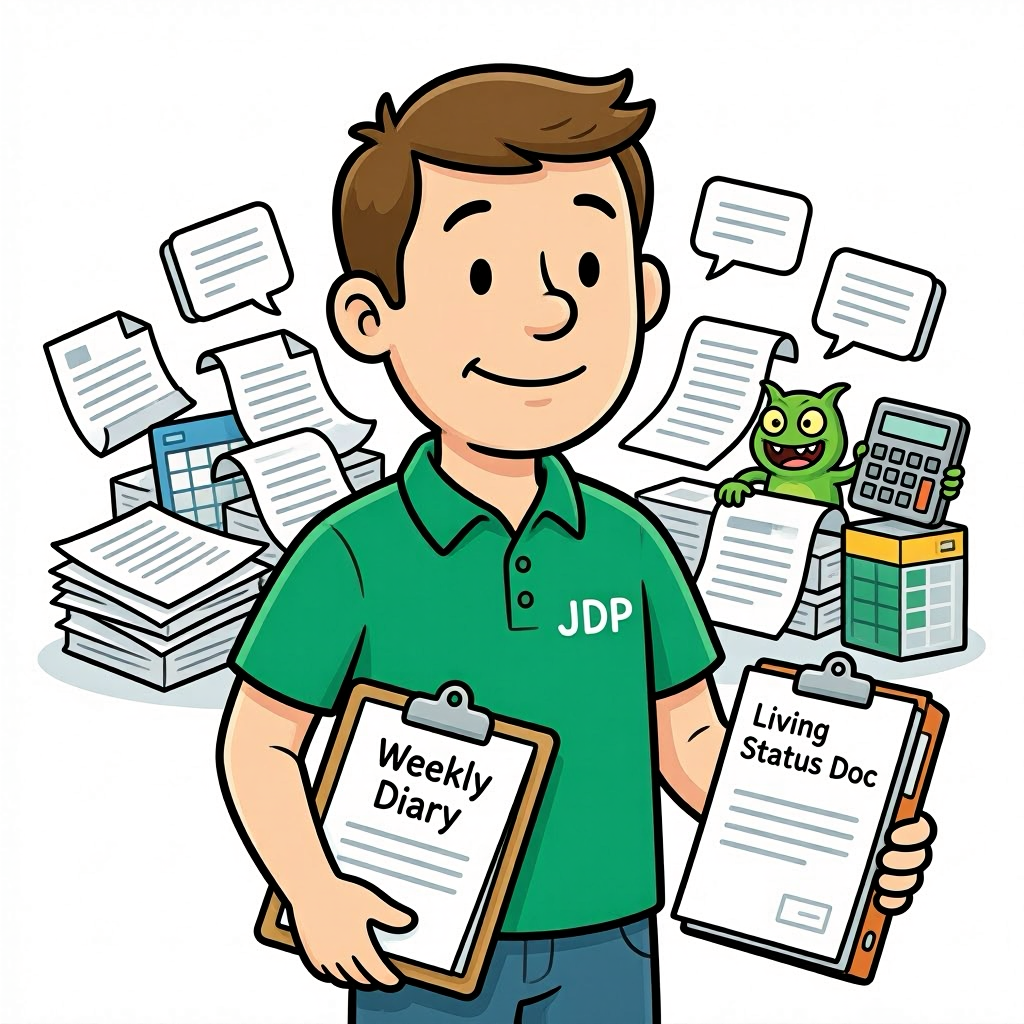
The Weekly Diary and Living Status Doc Model
Rather than dumping raw source material into a project indefinitely, synthesize it into two purpose-built documents each week. This maps directly onto disciplines already built into Triple A Program Delivery: the Weekly Diary functions like a Scrum Master's sprint history and information radiator combined, a chronological record that shows how the work actually unfolded. The Living Status Doc functions like a Project Manager's status report and a CPMAI Project Manager's phase tracker combined, a single current picture that replaces the need to reconstruct "where are we" from a stack of history every time someone asks.
| Weekly Diary | Living Status Doc | |
|---|---|---|
| Answers | What happened, and when | Where are we right now |
| Update pattern | Appended: a new dated entry each week | Updated in place: overwritten, not appended |
| Contents | Sprint updates, milestones, decisions, risks, action items, open questions | Current phase, active risks, milestone tracker, budget, stakeholder map |
| Reading pattern | Read chronologically, or searched for a specific past date or decision | Read as a snapshot, no history reconstruction required |
These two documents are not redundant. One tells the story over time. The other gives you the current picture without having to reconstruct it from history.
Rules for Handling Mixed and Conflicting Sources
A real project mixes transcripts, decks, and spreadsheets, and they will not always agree. This is exactly the kind of ambiguity that Triple A treats as a governance question, not a formatting inconvenience, and it maps directly onto the Trustworthy AI principle of not letting a model quietly resolve a conflict it was never given authority to resolve. The templates should account for this directly:
- File naming follows a consistent convention, YYYYMMDD-title, and the date in the file name, not the upload date, determines which week a file belongs to.
- Weeks run Monday through Sunday. A fixed boundary, applied consistently, so "this week" means the same thing every time someone or something reads the archive.
- Transcripts are the primary source for narrative and decisions. If you need to know why a call was made, the transcript is the record, not the deck that summarized it three slides later.
- Decks represent reported status as of that date, not verified fact. A deck saying "green" is evidence of what was reported, not confirmation that the project actually was green.
- Excel data takes precedence for anything quantitative. Budget, velocity, and hours come from the spreadsheet, not from someone's verbal recap of it.
- When sources conflict, record the conflict explicitly rather than quietly picking a winner. If a transcript says "on track" while the spreadsheet shows slippage, that discrepancy belongs in the documentation as a named open item, not smoothed over in favor of whichever source sounded more confident.
That last rule is the one most teams skip, and it is the one that matters most. A knowledge base that silently resolves conflicting inputs is making a governance decision without anyone deciding to make it. Recording the conflict keeps the judgment call where it belongs, with the people accountable for the project, not with whichever source got synthesized last.
Favor Markdown Over Word for These Two Documents
This is a formatting efficiency point, not a content quality one. A well-written Word document with clear headings will always beat a sparse slide deck, and Word still has a place in practitioner deliverables meant for human readers outside the AI workflow. But for documents purpose-built for retrieval and AI-assisted generation, Markdown is the more efficient choice, for a few concrete reasons:
- Nothing to extract. Markdown is plain text, so there is no document structure, styling layer, or embedded formatting for an AI tool to parse through before it gets to the content itself.
- Headers map directly to meaning. A Markdown header is a header, consistently, every time. A Word heading style can drift, get manually reformatted, or get applied inconsistently across a document without anyone noticing.
- Smaller and faster to process. Less overhead per file adds up quickly across a full archive of weekly documents.
- Claude can generate or update the file directly. With Markdown there is no risk of corrupting formatting the way there can be with a Word document being edited programmatically.
Chat Projects vs. Cowork Projects: Different Pressure on Pre-Synthesis
How much of this synthesis work needs to happen before upload depends on which Claude workspace you are using, a distinction covered in more depth in Claude Chat Projects vs. Cowork Projects.
Chat Projects rely on Retrieval-Augmented Generation: files are chunked and searched, and Claude retrieves the most relevant snippets. This makes pre-synthesizing your Weekly Diary before upload close to mandatory practice, because the retrieval layer only ever sees fragments, and fragments of a well-structured document retrieve far better than fragments of a raw transcript.
Cowork Projects use agentic file-system access, meaning Claude can read entire files and folders directly during a task. This lowers the pressure to pre-synthesize. You can hand Cowork a week's raw transcripts and decks along with the templates, and have it generate the Diary and update the Status Doc as the task itself. That is a meaningful difference in workflow, but it is not a license to skip the documentation discipline altogether. It shifts when the synthesis happens, not whether it needs to happen.
Practitioner Takeaway
None of this is about making Claude smarter. It is about not asking an AI tool to do the job of editorial judgment that only you, or your PM, Scrum Master, or CPMAI PM discipline, is positioned to do. The Weekly Diary and Living Status Doc model, the file-type rules, and the explicit handling of conflicting sources are all documentation governance decisions, and Triple A Program Delivery treats governance as the guardrail that makes AI adoption safe, not the overhead standing between you and it.
The volume of material you can throw at a Claude Project keeps growing. The discipline required to make that material actually useful has not changed at all, and it will not, regardless of how large the context window gets.